

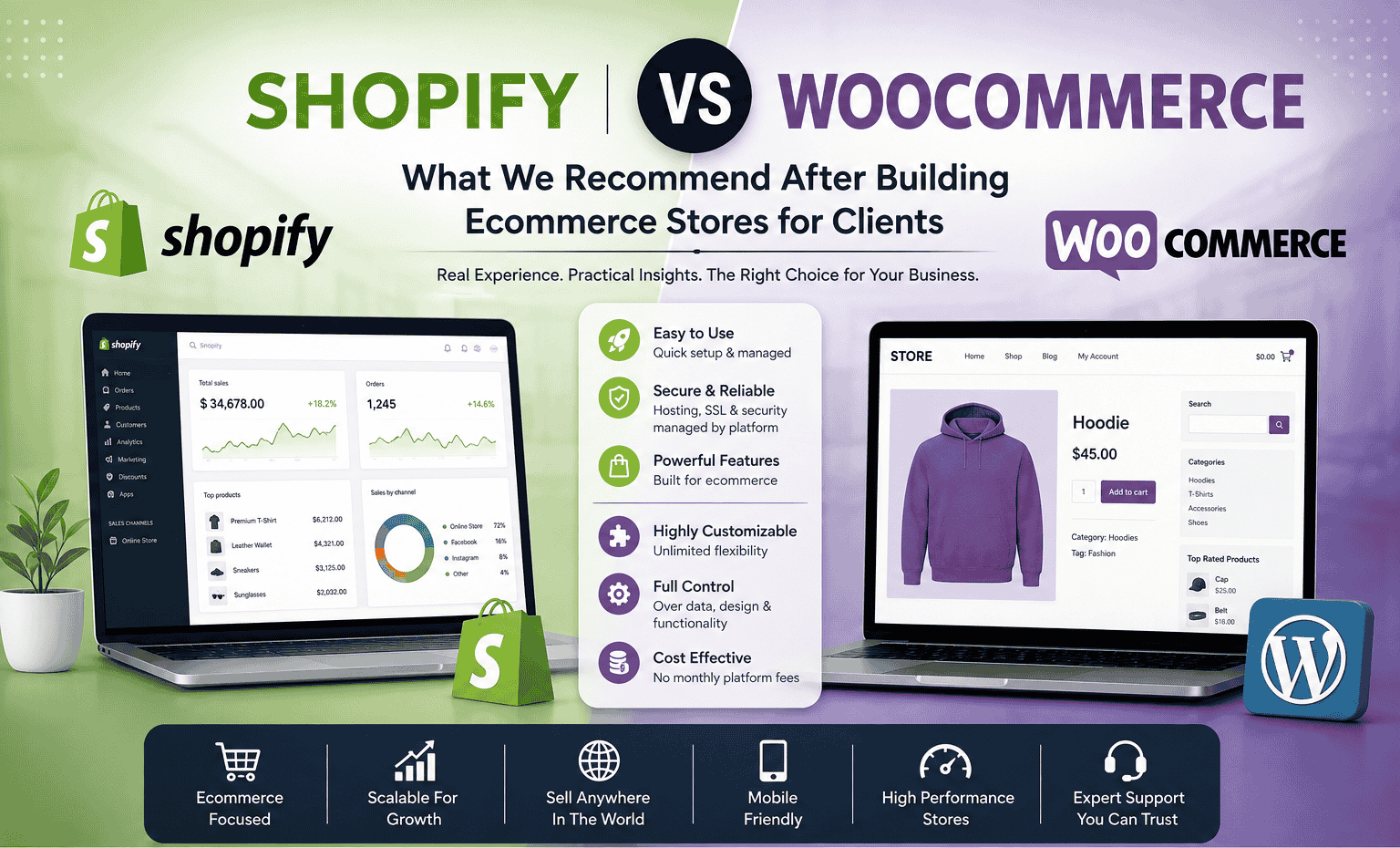
Choosing the right ecommerce platform is one of the most important decisions when starting or upgrading an online store.
Two platforms dominate most conversations: Shopify and WooCommerce.
Both are powerful, both can support successful businesses, and both have very different strengths.
At Syslotech, we have worked with ecommerce stores involving Shopify, WooCommerce, custom themes, third-party integrations, subscriptions, B2B functionality, payment systems, performance improvements, and custom development.
Based on that experience, we have learned that the question should not simply be:
“Which platform is better?”
The better question is:
“Which platform is better for your particular business?”
In this guide, we compare Shopify and WooCommerce from a practical development and business perspective and explain which platform we typically recommend depending on the project requirements.
Table of Contents
- Shopify vs WooCommerce: Quick Overview
- What Is Shopify?
- What Is WooCommerce?
- Ease of Setup and Store Management
- Design and Customization
- Ecommerce Features
- Apps and Plugin Ecosystem
- Shopify vs WooCommerce for SEO
- Website Performance and Speed
- Security and Maintenance
- Payment Gateway Options
- International Ecommerce
- B2B and Wholesale Ecommerce
- Subscription-Based Ecommerce
- Custom Development and Integrations
- Scalability and High-Traffic Stores
- Shopify vs WooCommerce Pricing
- Common Problems We See With Shopify Stores
- Common Problems We See With WooCommerce Stores
- Which Platform Do We Recommend?
- Shopify vs WooCommerce for Different Business Types
- How We Choose an Ecommerce Platform for Clients
- Future of Shopify and WooCommerce
- Conclusion
- FAQs
Shopify vs WooCommerce: Quick Overview
Shopify and WooCommerce can both be used to build professional ecommerce websites, but their technical architecture is very different.
Shopify is a hosted ecommerce platform. Shopify manages the hosting, infrastructure, SSL certificate, platform security, and much of the technical environment.
WooCommerce is an open-source ecommerce plugin built for WordPress. The website owner has greater control over hosting, plugins, databases, server configuration, and custom development.
Here is a quick comparison:
| Feature | Shopify | WooCommerce |
|---|---|---|
| Hosting | Included | Separate hosting required |
| Setup | Simple | Requires WordPress setup |
| Maintenance | Mostly managed | Developer/site owner manages |
| Customization | Highly customizable | Extremely customizable |
| Security | Shopify managed | Hosting/site owner managed |
| Apps/Plugins | Shopify App Store | WordPress plugin ecosystem |
| Content Management | Good | Excellent |
| Scalability | Very strong | Depends on infrastructure |
| Technical Control | Moderate | Very high |
| Best For | Ecommerce-focused brands | Flexible/custom websites |
Neither platform is automatically better.
The right choice depends on what your business needs today and what it may need in the next few years.
What Is Shopify?
Shopify is a fully hosted ecommerce platform designed specifically for online selling.
Businesses can create, manage, and scale their ecommerce operations without maintaining their own servers.
Shopify provides many important features out of the box, including:
- Product management
- Inventory management
- Order management
- Customer accounts
- Discount codes
- Payment integration
- Shipping configuration
- Analytics
- Themes
- Mobile-friendly checkout
- App integrations
- International selling features
Because Shopify controls the core infrastructure, businesses generally need to worry less about hosting, server updates, security patches, and platform compatibility.
This is one of the biggest reasons we often recommend Shopify to ecommerce-focused businesses.
What Is WooCommerce?
WooCommerce is an open-source ecommerce platform built on WordPress.
Instead of being a standalone hosted platform, WooCommerce transforms a WordPress website into an online store.
Its biggest advantage is flexibility.
Developers can access and customize almost every part of the system.
WooCommerce is especially useful for websites that combine ecommerce with other functionality such as:
- Blogging
- Membership systems
- Learning platforms
- Custom user dashboards
- Booking systems
- Business directories
- CRM integrations
- Custom forms
- Customer portals
- Complex workflows
WooCommerce gives businesses significantly more control over the website architecture.
However, greater control also creates greater responsibility.
Ease of Setup and Store Management
For businesses without an internal technical team, Shopify is generally easier to manage.
Shopify provides a structured admin dashboard where store owners can manage:
- Products
- Orders
- Customers
- Discounts
- Content
- Markets
- Analytics
- Apps
The hosting environment and ecommerce infrastructure are already configured.
WooCommerce requires additional setup.
You may need to manage:
- WordPress installation
- Hosting
- SSL
- WooCommerce configuration
- Payment gateways
- Caching
- Backups
- Security
- Plugin updates
Our Recommendation
For a business that wants to launch quickly and minimize technical management:
Shopify generally wins.
For a business with technical resources and more complex requirements:
WooCommerce can provide greater flexibility.
Design and Customization
Both platforms provide excellent customization options.
Shopify themes primarily use:
- Liquid
- HTML
- CSS
- JavaScript
- JSON templates
- Shopify sections and blocks
Modern Shopify themes provide considerable flexibility through the Shopify theme editor.
WooCommerce uses the WordPress ecosystem and commonly includes technologies such as:
- PHP
- HTML
- CSS
- JavaScript
- WordPress hooks
- WooCommerce hooks
- Custom plugins
WooCommerce gives developers deeper access to the underlying system.
However, most normal ecommerce requirements can still be implemented effectively within Shopify.
Our Recommendation
For standard ecommerce customization:
Shopify provides more than enough flexibility.
For highly customized backend workflows:
WooCommerce often provides more freedom.
Ecommerce Features
Shopify is built entirely around ecommerce.
This means many features required by ecommerce businesses are already integrated into the platform.
These include:
- Product variants
- Inventory
- Orders
- Discounts
- Customer accounts
- Shipping
- Taxes
- Analytics
- Abandoned checkout
- Multi-channel selling
WooCommerce offers similar functionality but often relies more heavily on additional plugins.
WooCommerce’s plugin-based architecture can be powerful but needs to be managed carefully.
Installing too many plugins can eventually create compatibility and performance issues.
Apps and Plugin Ecosystem
Both Shopify and WooCommerce have very large ecosystems.
Shopify provides apps for:
- Product reviews
- Email marketing
- Loyalty programs
- Subscriptions
- Upselling
- Cross-selling
- Search
- Filters
- Analytics
- B2B
- Shipping
- Customer support
WooCommerce provides thousands of WordPress plugins for similar functionality.
The major difference is control.
WooCommerce plugins can usually interact more deeply with the platform.
Shopify apps operate within Shopify’s platform architecture and APIs.
One Important Lesson From Our Experience
Installing an app or plugin should not always be the first solution.
We regularly see websites where unnecessary apps or plugins increase:
- Monthly costs
- Page load time
- JavaScript
- Database queries
- Maintenance requirements
Sometimes lightweight custom development is a better long-term solution.
Shopify vs WooCommerce for SEO
One of the most common questions we receive is:
Which platform is better for SEO?
The answer is that both can perform very well.
WooCommerce benefits from WordPress’s strong content-management system.
Businesses with extensive blogging and content strategies may find WooCommerce particularly useful.
Shopify also provides the essential SEO features required for most ecommerce websites.
These include:
- Editable page titles
- Meta descriptions
- Alt text
- Sitemap
- Canonical URLs
- Structured theme architecture
- Redirect management
However, SEO performance depends far more on implementation than platform selection.
Important factors include:
- Website speed
- Quality content
- Product descriptions
- Collection/category structure
- Internal linking
- Backlinks
- Technical SEO
- Structured data
- User experience
A properly optimized Shopify store can outperform a poorly configured WooCommerce website and vice versa.
Website Performance and Speed
Website performance is extremely important for ecommerce.
Slow websites can affect:
- Conversion rates
- User experience
- SEO
- Bounce rates
- Advertising performance
Shopify has an advantage because its infrastructure is centrally managed.
However, Shopify stores can still become slow due to:
- Too many apps
- Large images
- Excessive JavaScript
- Poor theme development
- Third-party tracking scripts
WooCommerce performance depends heavily on:
- Hosting quality
- Server configuration
- Database optimization
- Plugins
- Theme quality
- Caching
- CDN setup
A properly optimized WooCommerce website can be extremely fast.
But achieving that performance may require more technical management.
Security and Maintenance
Security is another important difference.
Shopify manages much of the platform-level security.
This includes:
- SSL
- Server infrastructure
- Platform updates
- Security patches
- PCI-related infrastructure
WooCommerce users are responsible for significantly more.
The website owner or development team needs to manage:
- WordPress updates
- Plugin updates
- PHP versions
- Security plugins
- Backups
- Malware protection
- Hosting security
Our Recommendation
Businesses without technical resources may find Shopify significantly easier to maintain securely.
Payment Gateway Options
Both platforms support numerous payment gateways.
Shopify supports:
- Shopify Payments
- PayPal
- Stripe-based integrations
- Regional payment methods
- Alternative payment gateways
WooCommerce also supports a wide range of payment providers through plugins and custom integrations.
WooCommerce can sometimes provide greater flexibility for unusual payment requirements because developers have more control over checkout functionality.
International Ecommerce
For brands planning to sell internationally, Shopify has become increasingly attractive.
Shopify provides tools for managing:
- Different markets
- Currencies
- Languages
- Regional domains
- Pricing
- Duties and taxes
- International storefront experiences
WooCommerce can also handle international ecommerce through plugins and custom configuration.
However, Shopify often provides a more centralized experience for businesses managing multiple international markets.
B2B and Wholesale Ecommerce
B2B ecommerce often involves requirements that are significantly more complex than normal retail ecommerce.
For example:
- Customer-specific pricing
- Wholesale catalogs
- Minimum order quantities
- Payment terms
- Company accounts
- Bulk ordering
- Customer-specific products
- Restricted products
Shopify provides advanced B2B functionality, particularly through Shopify Plus.
Custom Shopify solutions can also be developed using APIs, customer data, Shopify Functions, apps, and integrations.
WooCommerce offers strong flexibility through custom development and wholesale plugins.
Which Is Better?
It depends heavily on the business workflow.
For some B2B businesses, Shopify provides the cleaner long-term ecosystem.
For highly unusual pricing and workflow requirements, WooCommerce can provide greater flexibility.
Subscription-Based Ecommerce
Subscription ecommerce has become increasingly common.
Examples include:
- Monthly product subscriptions
- Membership products
- Repeat delivery
- Subscription boxes
- Consumable products
Shopify supports subscriptions through apps and Shopify’s subscription APIs.
WooCommerce provides several subscription plugins and can also support highly customized subscription systems.
For straightforward subscription ecommerce, Shopify is generally easier to maintain.
For complex subscription logic, the technical requirements should be reviewed before choosing a platform.
Custom Development and Integrations
Modern ecommerce businesses rarely operate with a website alone.
Stores often need to connect with:
- ERP systems
- CRM platforms
- Email marketing platforms
- Warehouses
- Inventory systems
- Accounting platforms
- Shipping providers
- Subscription platforms
- Custom applications
Both Shopify and WooCommerce support API integrations.
Shopify provides REST and GraphQL APIs together with webhooks and application development frameworks.
WooCommerce provides REST APIs and full access to WordPress/PHP development.
Our Experience
The platform should be selected after identifying critical integrations.
This can prevent expensive rebuilding later.
Scalability and High-Traffic Stores
Shopify is particularly strong when traffic scalability is important.
Businesses do not need to manually increase server resources during major campaigns.
This makes Shopify attractive for:
- Black Friday
- Seasonal promotions
- Product launches
- Influencer campaigns
- High-volume advertising
WooCommerce can also handle substantial traffic.
However, performance depends heavily on infrastructure.
A high-traffic WooCommerce website may require:
- Powerful cloud hosting
- CDN
- Object caching
- Database optimization
- Load balancing
- Server monitoring
Shopify vs WooCommerce Pricing
Comparing only the platform price can be misleading.
Shopify Costs Can Include
- Shopify subscription
- Premium theme
- Paid apps
- Custom development
- Payment processing
- Maintenance
Hosting is already included.
WooCommerce Costs Can Include
- Hosting
- Domain
- Premium themes
- Plugins
- Security
- Backup solutions
- CDN
- Maintenance
- Developer support
WooCommerce itself may be free, but the complete ecommerce solution is not necessarily free.
Which Is Cheaper?
There is no universal answer.
For a simple store, WooCommerce may cost less.
For a growing store requiring ongoing technical maintenance, Shopify may offer more predictable costs.
Common Problems We See With Shopify Stores
Shopify is reliable, but poorly implemented stores can still experience problems.
Some common issues include:
Too Many Apps
Every small requirement gets solved by installing another app.
This can increase cost and affect performance.
Heavy Themes
Large JavaScript libraries and unnecessary features can make themes slow.
Poor Custom Code
Incorrect Liquid or JavaScript customization can create problems when themes are updated.
App Conflicts
Several apps may attempt to modify the same part of the storefront.
Lack of Long-Term Planning
Features may be added individually without considering the overall architecture.
Common Problems We See With WooCommerce Stores
WooCommerce stores can experience a different set of issues.
Too Many Plugins
This is probably the most common problem.
A website can eventually accumulate dozens of plugins.
Plugin Conflicts
Different plugins may modify the same WordPress or WooCommerce hooks.
Outdated Software
Old plugins, themes, PHP versions, and WordPress installations can create security risks.
Poor Hosting
Cheap shared hosting can create significant performance problems for ecommerce.
Database Issues
Large WordPress databases may require optimization as the website grows.
Which Platform Do We Recommend?
If we have to provide a general recommendation for a traditional ecommerce business:
We often recommend Shopify.
Why?
Because it provides:
- Reliable infrastructure
- Easier maintenance
- Strong ecommerce features
- Good scalability
- Large app ecosystem
- Easier store administration
- International commerce features
- Less server management
However, this does not mean Shopify is always better.
We recommend WooCommerce when the project requires:
- Deep WordPress integration
- Extensive content management
- Custom backend functionality
- Specialized workflows
- Greater control over infrastructure
- Complex application-like features
Shopify vs WooCommerce for Different Business Types
Small Ecommerce Startup
Recommended: Shopify
It allows the business to launch quickly without managing technical infrastructure.
Existing WordPress Business
Recommended: WooCommerce
If WordPress is already heavily integrated into business operations, adding WooCommerce may be practical.
Fast-Growing D2C Brand
Recommended: Shopify
Shopify’s ecosystem and scalability make it attractive for growing ecommerce businesses.
Content-Based Ecommerce Website
Recommended: WooCommerce
WordPress provides excellent content-management capabilities.
International Brand
Recommended: Shopify in many cases
Shopify’s market management capabilities simplify international ecommerce.
Highly Customized Business System
Recommendation: Technical assessment required
Depending on the requirements, WooCommerce, Shopify with custom development, or even a custom ecommerce application may be appropriate.
How We Choose an Ecommerce Platform for Clients
At Syslotech, we do not recommend technology based solely on popularity.
Before recommending a platform, we normally analyze factors such as:
- Number of products
- Number of variants
- Expected traffic
- Target countries
- Payment gateways
- Shipping requirements
- Subscription requirements
- B2B requirements
- CRM integrations
- ERP integrations
- Inventory systems
- Marketing systems
- Internal team capabilities
- Content requirements
- Future functionality
- Development budget
- Maintenance requirements
This allows us to think beyond the first version of the website.
A good ecommerce platform should continue supporting the business as it grows.
Future of Shopify and WooCommerce
Both Shopify and WooCommerce will remain major ecommerce platforms.
Shopify continues investing heavily in:
- AI
- Automation
- B2B
- Global commerce
- Checkout
- App development
- Enterprise ecommerce
WooCommerce continues benefiting from the flexibility and massive ecosystem surrounding WordPress.
At the same time, ecommerce architecture is becoming increasingly connected.
Modern stores are integrating with:
- AI systems
- CRM platforms
- Marketing automation
- ERP software
- Warehouse systems
- Headless frontend technologies
- Mobile applications
Because of this, choosing a platform should no longer be based only on how today’s website looks.
Businesses should consider how easily the platform can integrate with their future technology ecosystem.
Conclusion
Shopify and WooCommerce are both excellent ecommerce platforms, but they solve problems differently.
Shopify is generally better for businesses that want a reliable, scalable, managed ecommerce platform with less technical maintenance.
WooCommerce is generally better for businesses that want maximum flexibility, deeper WordPress integration, and greater control over the overall technical environment.
There is no single platform that is best for every business.
At Syslotech, our approach is to understand the business requirements first and choose the technology second.
Before deciding, consider:
- Your products
- Your customers
- Your team
- Your integrations
- Your growth strategy
- Your technical requirements
- Your long-term maintenance costs
Choosing the right platform at the beginning can save significant development time and migration costs in the future.
If you are planning a new ecommerce website or considering migrating between Shopify and WooCommerce, Syslotech IT Solutions can help you evaluate your requirements and choose the right technical approach.
FAQs
Q1. Is Shopify better than WooCommerce?
Ans: Neither platform is universally better. Shopify is generally better for businesses wanting a managed and easy-to-maintain ecommerce platform, while WooCommerce provides greater control and customization.
Q2. Is WooCommerce cheaper than Shopify?
Ans: WooCommerce itself is free, but hosting, plugins, security, maintenance, and development costs need to be considered. Depending on the project, the total cost can sometimes be similar to or greater than Shopify.
Q3. Which is better for SEO: Shopify or WooCommerce?
Ans: Both platforms can perform well in SEO. WooCommerce provides more content-management flexibility through WordPress, while Shopify provides all the important SEO functionality required by most ecommerce businesses.
Q4. Is Shopify better for large ecommerce stores?
Ans: Shopify is an excellent choice for high-volume ecommerce because infrastructure and scalability are largely managed by Shopify. WooCommerce can also support large stores when backed by properly configured infrastructure.
Q5. Can I migrate from WooCommerce to Shopify?
Ans: Yes. Products, customers, orders, collections, images, redirects, and other data can be migrated. The migration should be planned carefully to preserve SEO and important store data.
Q6. Can I migrate from Shopify to WooCommerce?
Ans: Yes. Shopify stores can be migrated to WooCommerce, although custom features, apps, and integrations may need to be rebuilt.
Q7. Which platform is better for international ecommerce?
Ans: In many cases we recommend Shopify because of its centralized international market and currency management. WooCommerce can also support international stores with the appropriate configuration.
Q8. Which platform is better for B2B ecommerce?
Ans: It depends on the requirements. Shopify Plus provides strong B2B capabilities, while WooCommerce can support highly customized wholesale workflows through plugins and custom development.
Q9. Which platform requires less maintenance?
Ans: Shopify generally requires less technical maintenance because Shopify manages hosting, server infrastructure, and core platform updates.
Q10. How do I know which ecommerce platform is right for my business?
Ans: The best approach is to evaluate your products, expected traffic, integrations, countries, payment methods, subscriptions, B2B requirements, budget, and future growth plans before choosing a platform.